Home About Tools Pricing Blogs Contact Login Try Free

Your Inbox Is Costing You, More Than You Think

Every invoice your team manually touches is A$27.67 in hidden cost. Here’s why leading Australian organisations have stopped paying that tax – and what they switched to.

There’s a ritual that plays out in accounting firms and finance teams across Australia every single day. An email arrives with a PDF attachment. Someone opens it, squints at the supplier name and amount, opens the accounting software, and starts typing. Then the next one arrives. And the next.

We’ve dressed this up with names like “invoice processing” and “accounts payable management.” But let’s call it what the research says it is: an invisible tax on your team’s time and your firm’s bottom line.

The document-capture software market has spent the last decade promising to fix this. Dext (formerly Receipt Bank), Hubdoc, AutoEntry, and their peers all offer some version of the same pitch: snap a photo or forward an email, and the data appears in Xero. For many firms, these tools have been genuinely transformative. But in 2026, a new class of competitor is exposing some uncomfortable truths about the incumbents – and Australian accounting firms and finance teams are taking notice.

This is a detailed look at how the leading tools compare, where each one falls short, and why a new entrant – AirDoc AI – is winning clients from some of the country’s most demanding finance operations.

The Real Cost of “Good Enough”

Before comparing software, it’s worth anchoring on the scale of the problem. Industry research paints a confronting picture for any firm still relying on manual or semi-manual invoice handling:


A$27.67
Average cost to process a single PDF invoice manually
ATO & Deloitte Access Economics
17.4
Days average processing time per invoice without automation
Ardent Partners, 2024
1.6%
Manual data entry error rate – each error costs up to A$53 to fix
Industry Data, ResolvePay
7.5d
Faster monthly close for teams that automate routine processing
Stanford GSB, 2025

For an accounting practice processing 500 invoices a month across its client base, the manual cost alone exceeds A$13,800 per month in staff time. The tools reviewed below all reduce that figure – but not equally, and not without their own friction and costs.


What the Market Looks Like in 2026

Reviewing thousands of user ratings across G2, Capterra, Trustpilot, the Xero App Store, and practitioner communities on Reddit and LinkedIn, a clear picture emerges: the praise across every product is remarkably similar (saves time, easy capture, syncs with Xero) – but the complaints are where products diverge, and where decisions should be made.

Hubdoc – stalled development, lost its flagship feature

Xero removed bank-statement “fetch” in 2022 and formally marked line-item extraction “not in pipeline” in mid-2025. Its Xero App Store rating sits around 3.3-3.5 stars – far below competitors in the very store that matters most to accountants.


Dext – best-in-class accuracy, but brutal pricing trajectory

Annual renewals rising 10-30% since the 2021 IRIS acquisition. The per-client model with a 10-client minimum penalises firms with many small clients. Support is slow (24-48h responses, no phone line) and billing disputes are a recurring complaint.


AutoEntry – sync failures and expiring credits

Items marked “published” that vanish before reaching Xero or Sage. Credits expire after 90 days. Perceived as stagnant since the Sage acquisition. Mixed Trustpilot picture: great support agents alongside persistent glitches.


Expensify – powerful for employees, problematic on contracts

A D- BBB rating driven by auto-renewal complaints and near-impossible cancellation. A 2024-25 UI overhaul was widely criticised. Built for employee expense submission, not accountant-side document capture – a category mismatch many buyers miss.


The pattern is consistent: incumbents built their reputation solving the capture problem. But in 2026, the battleground has shifted. Firms don’t just need their invoices scanned – they need the entire workflow from inbox to Xero to require zero human touches. That’s a fundamentally different product requirement, and it’s where the market is moving.


Enter AirDoc AI: The Inbox-First Approach

Most document-capture tools require a human bridge: someone must forward the email, snap the photo, or upload the file. The tool then processes it. The human is still part of the loop – just handling a different step.

“Clicking through emails to verify invoices isn’t ‘accounting’. It’s busywork. It’s a massive, invisible drain on your team’s focus and your firm’s bottom line.”
– AirDoc AI

AirDoc AI attacks the problem at a different point. Rather than waiting for someone to submit a document, it connects directly to your Microsoft 365 inbox, monitors for incoming invoices automatically, extracts the data – supplier details, line items, GST – and posts directly to Xero. The human bridge is removed entirely.

This matters for Australian firms and finance teams for a specific reason: the dominant failure mode isn’t bad OCR or poor integrations. It’s friction at the front end. Suppliers email invoices. Those invoices sit in inboxes. Someone has to remember to process them. AirDoc eliminates that step.

Secure inbox connection

Connects to Microsoft 365 and automatically identifies all emails containing invoices – no forwarding rules needed.

Intelligent extraction

Trained on thousands of formats. Reads PDFs, images, and text – extracting supplier details, line items, and GST with precision.

Direct Xero posting

Extracted data is structured and posted to Xero immediately. Your books stay current without Friday afternoon backlogs.

Complete audit trail

Every invoice is logged with full traceability – what was processed, when, and how. Total visibility for compliance.


Head-to-Head: How AirDoc Compares

Based on cross-platform review analysis and published product specifications as of June 2026:

CRITERIA AIRDOC AI DEXT HUBDOC AUTOENTRY
Workflow trigger Automatic (inbox monitoring) Manual submission / email-in Manual submission Manual / email-in
Line-item extraction Yes, included Yes (may be add-on) No – not in roadmap Yes, included
GST / tax handling Automatic, ATO-aligned Yes Basic Yes
Xero integration Direct, real-time Mature, real-time Native (Xero-owned) Yes (some sync issues reported)
Audit trail Complete, per-invoice log Yes Basic Yes
Pricing model Subscription, by email volume Per-client, 10-client min Free / bundled with Xero Credit packs (expire 90 days)
Price trajectory Transparent, locked +10-30%/yr since 2021 Stable (free tier) Stable, credit changes noted
Setup overhead Near-zero (inbox connect) Supplier rules per client Moderate Moderate
Human step required None for standard invoices Submit / forward email Upload / mobile capture Upload / email-in
Bank-statement fetch Not primary use case Yes (select banks) Retired 2022 Yes
Free trial / entry tier 500 free emails/month, no card Trial, then paid Free with Xero subscription Trial available
Support model Direct support Email only, 24-48h Xero support Live chat (praised, but reactive)

The table reveals something important: AirDoc doesn’t win on any single feature in isolation. It wins on the combination of automation depth (no human trigger required), pricing transparency (pay per invoice, no minimums, no expiry), and workflow fit (most supplier invoices arrive by email – AirDoc is built precisely for that reality).


Real Results From Australian Organisations

AirDoc AI isn’t a startup promise – it’s already deployed in some of Australia’s most demanding finance environments:

MUTUAL TRUST

Australia’s largest multi-family office automated invoice processing from a single inbox, saving 30+ hours per month. CFO Jason Smith credits AirDoc with freeing his team for higher-value client advisory work.

SA AGRI-BUSINESS

A 150+ year South Australian agricultural enterprise uses AirDoc to automate administration and reduce operational costs – proving the solution scales across industries, not just accounting practices.

PREMIUM BEVERAGE BRAND

A fast-growing Australian premium beverage company uses AirDoc to eliminate invoice admin, freeing leadership bandwidth to focus on commercial growth rather than back-office processing.

These aren’t early-adopter experiments. These are established, operationally sophisticated Australian organisations that evaluated the full market and chose AirDoc for its combination of automation depth, reliability, and ROI clarity.


The Pricing Case Is Unusually Clear

One of the most common frustrations in the document-capture category – surfaced repeatedly in review data – is pricing complexity and unpredictability. Dext’s per-client model penalises growth. AutoEntry’s credits expire. Expensify auto-upgrades without notice.

AirDoc takes a different approach: pay for what you scan, start for free, no credit card required.

Best value
Starter
Free

500 emails scanned per month. No credit card required.

Growth
A$149 / month

2,000 emails per month. Under A$0.08 per email.

Scale
A$299 / month

5000 emails per month. Under A$0.06 per email.

Enterprise
A$499 / month

10,000 emails per month. Under A$0.05 per email. Talk to Support for higher volume.

For a business scanning 2,000 invoice emails a month, the Growth plan works out to well under A$0.10 per email – compared to A$27.67 for manual processing per invoice, and a significant saving versus Dext’s per-client model at similar volumes. The break-even calculation is rarely close.

“Emails scanned” means inbox emails monitored, not a cap on invoices – every invoice found within those emails is processed. For most small businesses, the free tier (500 emails/month) covers their entire invoice volume at no cost.

We are here to earn your trust; not assume it

A look at the principles that shape how AirDoc AI builds, listens, and grows and what we believe the relationship between a software company and its customers should actually look like.


Most software companies ask you to trust them before they’ve shown you anything. The pitch deck comes first. The promise comes first. The contract, often, comes before a single meaningful outcome has been delivered. We understand why; building software is expensive and uncertain, and companies need commitment to survive long enough to deliver. But understanding the logic doesn’t make it any less backwards.

At AirDoc AI, we’ve chosen to operate on a different premise. We want to earn our revenue. Not collect it. Not retain it through habit or switching costs or carefully crafted lock-in. We want every dollar we receive from a customer to represent value that we have genuinely delivered to them via time freed, errors reduced, processes that used to require human attention running quietly and correctly on their own.

That’s not just a philosophy statement. It changes how we build, how we talk to our customers, and what we consider success. This article is about all of that.

“We want every dollar we receive to represent real value delivered. That constraint forces us to be honest about what we’re building and careful about the promises we make.”

The mission is larger than invoices

AirDoc AI today processes invoices. It connects to your inbox, reads the attachments, extracts the data, and posts it to your accounting platform automatically. That’s the current form – focused, functional, and proven.

But the mission is broader than that, and we think it’s worth being clear about where this is going. We are building a platform for document handling and management automation across industries. Not just accounting, not just invoices, not just one platform. The vision is a world where the enormous volume of structured and semi-structured documents that flow through business operations every day such as invoices, purchase orders, delivery notes, bank statements, contracts, tax documents, and compliance records are handled automatically, accurately, and without anyone needing to be the bridge between a received document and the system that needs to know about it.

We are building in stages – proving the model with invoice automation, then expanding to the full document operations landscape.

We are building toward that vision in stages. The reason we start with invoices is not that invoices are the whole story. It’s that invoices are the place where we can prove the model works (where the problem is clearly defined, the outcome is measurable, and the customer benefit is immediate and tangible). Every capability we add from here is built on a foundation we know is solid, not a promise we’re hoping to fulfil later.

How we actually work with customers

Here is the part that we think matters most, and the part that most distinguishes us from how software companies typically operate in this space.

We reach out to our customers. Proactively, regularly, and with genuine curiosity. Not to check whether their invoice is paid. Not to upsell them on a tier they haven’t asked about. But to understand how they are actually using AirDoc AI, what’s working well, what’s creating friction, and where the product is falling short of what they need.

Most software vendors wait to hear from you. Again the logic is understandable; every inbound complaint is a data point, and low complaint volume is treated as a proxy for satisfaction. But silence isn’t satisfaction. Silence is often just tolerance. People put up with software that doesn’t quite fit because switching is painful and good enough is good enough, for now. We don’t want “good enough” customers. We want customers who are genuinely getting what they came for, and we can only know that by asking.

This is not a marketing loop. It is how we actually build. Every challenge a customer raises is a product problem we
take seriously.

When we hear about a challenge, we don’t file it away for the next quarterly planning cycle. We treat it as a product problem – one that belongs on our immediate radar and that we are responsible for solving. The goal is straightforward: if you came to AirDoc AI because of a specific problem, that problem should get easier over time, not harder. And if our product is creating new friction that didn’t exist before, we want to know about it immediately and fix it before it becomes your reason to leave.

The promise we made and intend to keep

When we pitched AirDoc AI to our earliest customers, we made a simple and specific promise: connect your inbox to your accounting platform, and the invoice work goes away. Completely. You won’t be opening attachments. You won’t be entering line items. You won’t be chasing down supplier details. The data will be in your system, accurately, the moment the email arrives.

That promise hasn’t changed. It won’t change. Everything we build, every capability we add, every platform we integrate with, is in service of that promise and its natural extension into other document types and other workflows. We are not adding features to add features. We are adding capabilities because our customers tell us where the work still lives that doesn’t need to live there.

What you can hold us to

  1. Your time is what we are here to protect
    Every capability AirDoc AI adds must free up time that currently requires human attention. If a feature doesn’t do that, it doesn’t belong in the product.
  2. Accuracy is non-negotiable
    The reason people still touch documents manually is because errors in financial records are costly. We will never trade accuracy for speed or scope quality of information reporting is foundational.
  3. Your feedback shapes what we build next
    Our roadmap is not written in a boardroom. It is written in the honest conversations we have with customers about where the product still falls short.
  4. We will always be reachable
    No ticket queue that goes nowhere. No chatbot deflecting your question. If you are a customer of AirDoc AI and something isn’t right, we want to hear from you directly and quickly

What “always reachable” actually means

We want to be specific about this, because it’s easy to say and hard to mean. Every user of AirDoc AI has direct access to the team. Not to a support tier. Not to a knowledge base that may or may not contain the answer they need. To us – the team building the product.

If you’re onboarding and something doesn’t connect the way it should, reach out. If you’re three months in and a new supplier’s invoice format is coming through incorrectly, reach out. If you have an idea for how the product could work better for your specific workflow (A document type you wish we handled, a platform you need integrated, a reporting format that would make your life easier) reach out. These conversations are not an interruption to our work. They are our work.

Proactive check-ins

We come to you. We don’t wait for problems to escalate into complaints before we start listening.

Direct conversation

No support tiers. No deflection. A real conversation with the team who built what you’re using.

Fast response

When something isn’t right, we want to know and fix it quickly; before it compounds into a bigger problem.

Your ideas, our roadmap

If you tell us your workflow needs something specific, that need goes directly into how we plan what to build next.

We know that this approach doesn’t scale indefinitely in the same form. As AirDoc AI grows, we will need to be thoughtful about how we maintain this kind of direct relationship with a larger customer base. But we want to build the muscle now with the instinct to reach out, the practice of listening carefully and the culture of treating customer feedback as the most valuable input we have so that the relationship doesn’t erode as we grow. It just evolves in form, not in spirit.

The broader picture – why this matters now

The accounting and finance profession is at an interesting inflection point. Automation is becoming genuinely accessible to operations of all sizes; not just enterprises with dedicated IT teams and six-figure software budgets. The question isn’t whether to automate any more. It’s which tools you trust to handle work that matters.

That trust question is one we take seriously. When you connect AirDoc AI to your inbox and your accounting platform, you are trusting us with information that is sensitive, consequential, and important. Your supplier relationships. Your financial records. Your compliance obligations. We do not take that lightly, and we think the way to honour it is not just through good engineering, though that matters, but through the kind of ongoing relationship we’ve described here. Earning the right to be trusted, continuously, by showing up and delivering.

Our Commitment

We do not measure success by subscription numbers alone. We measure it by whether the customers using AirDoc AI are genuinely better off than before they started; with less manual work, more accurate records, and more time for the things that actually need their attention. That standard is what we hold ourselves to, and it is what we invite you to hold us to.

A letter to the accounting community

If you are an accounting manager, a bookkeeper, a finance lead, or a business owner who handles your own books, we built AirDoc AI for you. Not for a hypothetical customer in a product brief, but for the actual person who opened their inbox this morning and saw three more invoices waiting.

We know this space well enough to know that trust in a new tool is hard-won and easily lost. We are not asking you to take a leap of faith. We are asking you to try something that works, speak to us when it doesn’t, and let us prove over time that we mean what we say about how we work with our customers.

The door is genuinely open. It always will be.


The AirDoc AI team
Building better document operations, one customer conversation at a time

Start a conversation with us.

Whether you’re ready to connect your inbox or just have questions about whether AirDoc AI fits your workflow, we’re here, and we’re happy to talk.

No sales script. No pressure. Just an honest conversation about whether this is right for you.

It’s just processing invoices.

An honest account of the scepticism we’ve faced, the managers who tried it anyway, and the number that has stayed at zero since day one.

An honest account of the scepticism we’ve faced, the managers who tried it anyway, and the number that has stayed at zero since day one.


We want to start this one differently. No grand opening claim. No statistic designed to make you feel behind. Just an honest account of what we keep hearing when we walk into rooms with accounting managers and operations leads and what’s happened when a small number of them decided to give us thirty minutes anyway.

The feedback we hear most often, from experienced, switched-on professionals, goes something like this: “I get it. But it’s only doing invoices. We’ve got bigger problems to solve.”

Fair. Completely fair. We’ve sat across that table enough times to know it’s not dismissiveness it’s the response of someone who has seen a lot of tools come through the door promising transformation and delivering marginal gains. The accounting software space is cluttered with solutions that solve yesterday’s problem in a slightly shinier way. Healthy scepticism isn’t cynicism. It’s experience.

So we’re not here to argue. We’re here to tell you what happened when the sceptics tried it.


“I didn’t think there was time being wasted. I genuinely thought we had this under control. The first month showed me we didn’t.”

Operations Manager, professional services firm, Sydney

The invisible time problem

Here’s the thing about time spent on invoice processing: it doesn’t announce itself. It doesn’t appear as a line item in your operational costs. It doesn’t show up in a dashboard. It dissolves quietly, consistently, across dozens of small interactions spread through the week. The email you open at 8:47am before the day properly starts. The ten minutes between calls. The reconciliation task you leave for Friday that bleeds into the weekend.

Most of the managers we’ve spoken to have never actually measured this. Not because they’re not rigorous; they are, but, because there’s no natural forcing function to count it. It’s just part of the job. It’s always been part of the job.

When managers who decided to trial AirDoc AI reflect on the first few weeks, almost all of them describe the same moment: the realisation that they weren’t just saving the time they thought they were spending. They were recovering time they didn’t know they were losing.

The email triage that happens before an invoice gets opened. The context-switching penalty each time you move from a creative or strategic task to a data-entry one. The Friday afternoon spent catching up on a week of unprocessed bills. The minor errors that surface during reconciliation because a figure was transposed at 4:30pm on a Thursday. None of these show up in anyone’s time estimate. All of them disappear when the inbox-to-Xero path is automated completely.

Time they didn’t track

Hours lost to inbox triage, attachment hunting, and re-entry after errors never logged, never measured

Attention they reclaimed

Focus fragmented by repetitive switching returned to higher-value, higher-satisfaction work

Books that stayed current

Xero updated the moment invoices arrived no more Friday catch-ups, no more backlog surprises

What the numbers say unedited

We could fill a page with metrics here. We won’t. There’s one number that matters more than any other, and we want to talk about it directly.

0%

Customer churn rate since launch

Every customer who has connected AirDoc AI to their inbox and accounting platform is still using it. Not one has left. Not one has asked to cancel. We think that says more than any feature list we could write because it means that once people experience what fully hands-off invoice processing actually feels like, they don’t want to go back to doing it themselves.

We want to be careful not to overstate this. Our user base is growing, not enormous. But it is growing entirely from satisfaction, not from marketing spend or lock-in contracts. People stay because the product delivers something they realise they can’t do without once they’ve had it.

That’s the dynamic we want more of the accounting community in Australia to experience. And that’s genuinely why we’re writing this.

We are not asking you to take our word for it. We are asking you to take the word of every customer who has tried AirDoc AI, weighed it against every alternative available, and chosen to stay. The 0% churn rate isn’t a marketing claim it’s a statement of what’s happened so far, and we think it’s the most honest case we can make.

The “it’s only invoices” objection, addressed directly

Here’s where we want to be genuinely candid. The managers who say “it’s only doing invoices” are not wrong to observe that today’s scope is focused. Invoice capture and posting is what AirDoc AI does right now and it does it better than anything else in this space because it’s the only tool that connects directly to your inbox and removes your involvement entirely.

But the reason we’re confident enough to talk about scope is because the foundation being laid is much broader than invoices. The same infrastructure that watches your inbox, reads a document, extracts structured data, and posts it to an accounting platform can be extended to every document type in your workflow. And we’re building that right now, alongside the conversations you and I are having.

Live now

Invoice processing

Inbox-connected, fully automatic capture and Xero posting. Hands-off from day one.

Coming soon

All document types

Purchase orders, delivery dockets, contracts, statements the same inbox-to-platform intelligence, broader scope.

Coming soon

Bank reconciliation

Matching transactions to bills and records automatically closing the loop on the full AP workflow.

Coming soon

More platforms

MYOB, QuickBooks, Sage, and additional email providers meeting your team where you already work.

The customers using AirDoc AI today aren’t just getting a working solution for their invoice problem. They’re getting early access to a platform that will eventually handle most of the document-heavy, data-entry work that flows through accounting operations. And they’re getting it at a time when the feature set is targeted, simple, and proven.

Why now is actually the right time

There’s a counterintuitive case to be made for trying a focused tool before it becomes a comprehensive one. When scope is limited, implementation is fast. When the workflow is narrow, there’s very little that can go wrong. When the onboarding is measured in minutes rather than months, the risk of trying is close to zero.

The managers who signed up early didn’t take a leap of faith. They took a thirty-minute trial. They connected their inbox. They watched a week of invoices process themselves while they worked on other things. They looked at their Xero account at the end of that week and saw it fully current without having touched it. Then they kept their subscription.

Week One

Connection set up. Inbox linked to Xero. First invoices processed automatically within hours. No intervention required.

End of Week One

The reaction almost every early user describes: “I kept waiting for something to go wrong. Nothing did.”

Month One

The hidden time becomes visible for the first time. Users notice what Friday afternoons feel like without a reconciliation backlog.

Month Two Onwards

The new normal. Books current. Time recovered. Zero customers have gone back to doing it manually.

An honest ask from us to you

We’re not going to tell you this will change your business overnight. We’re not going to promise that invoice automation is the missing piece in your operational strategy. We don’t know enough about your specific situation to make those claims, and we wouldn’t make them even if we did.

What we will say is this: the accounting community in Australia is full of smart, experienced professionals who are carrying a quiet operational cost that they’ve never had a reason to measure. Some of those professionals have tried AirDoc AI. None of them have left.

We’d like you to be next not because we need the number, but because we think you deserve to know what it feels like to not be doing this work yourself. The setup takes less time than the meeting where you’d normally hear a pitch. And unlike most pitches, the proof doesn’t ask you to imagine the outcome. It asks you to experience it.

One week. One connected inbox. See what your Friday afternoon looks like when the backlog isn’t waiting for you.

Try it. One week is all it takes.

Connect your inbox, link your Xero account, and let AirDoc AI run for seven days. No invoice entry. No manual posting. Just your books current, accurate, and waiting.

No lock-in contracts. Set up in under 15 minutes. Cancel anytime though nobody has.

AI is not coming for accountants

What the data actually says about AI and accounting jobs and why the leaders who act on this first will be the ones who come out ahead.

The conversation about AI and jobs has been going around in circles for a while now. On one side: the alarm millions of roles will disappear, automation is coming for white-collar workers, the accounting profession as we know it is finished. On the other: the reassurance AI is a tool, not a replacement, it will free you up to do more meaningful work, you have nothing to worry about.

Both versions are partial truths that, taken alone, mislead more than they inform. The reality is more nuanced, more specific, and if you are prepared to look at it honestly more actionable than either camp suggests.

This piece is an attempt at that honest look. We’ll use actual data, cite where it comes from, and end with a practical point about what accounting leaders should be doing right now. Let’s start with what the research says.

The global picture: displacement and creation happening simultaneously

The largest ongoing study of AI’s impact on employment comes from the World Economic Forum. Their 2025 Future of Jobs Report, which surveyed more than 1,000 employers representing 14 million workers across 55 economies, paints a picture of simultaneous disruption and creation.

92M

jobs projected to be displaced by AI by 2030

WEF FUTURE OF JOBS REPORT 2025
170M

new jobs projected to be created in the same period

WEF FUTURE OF JOBS REPORT 2025
86%

of businesses say AI and information processing will affect their operations by 2030

WEF FUTURE OF JOBS REPORT 2025

The net figures a projected gain of 78 million jobs globally are less useful than the composition of those numbers. The jobs being displaced are, with remarkable consistency across every study and sector, the ones characterised by being routine, rule-based, and data-intensive. The jobs being created are, equally consistently, the ones that require judgement, relationship, creativity, and strategic thinking. The profession is not disappearing. It is sorting itself into two categories: work that machines can do better, and work that humans will always do better. And one of those categories is shrinking.

What the accounting industry itself is saying

Karbon’s 2024 State of AI in Accounting Report surveyed 595 accounting professionals globally and found a profession that is clear-eyed about the change coming even if not yet fully prepared for it.

Accounting professionals are clear that AI will reshape the profession and that those who don’t adopt it
will fall behind.

That last figure is worth sitting with. Two in three accounting professionals believe that AI adoption is already a competitive advantage not a future consideration, but a present-day differentiator between firms pulling ahead and those standing still. And yet, despite that belief, the same study found that only 25% of firms are actively investing in AI training for their teams. The gap between what people believe and what they are doing is exactly where risk accumulates.

For the sharpest illustration of how fast the shift is occurring: Wolters Kluwer’s 2025 Future Ready Accountant report found that AI adoption in accounting firms jumped from just 9% to 41% in a single year. Whatever window exists to adopt early rather than adopt late is closing faster than most people in the profession realise.

So which accounting tasks are actually going?

Here is where the conversation stops being abstract. The research is not saying that accountants are going. It is saying, very specifically, that certain types of accounting work are going and it identifies them clearly. They share a set of defining characteristics.

TASKS WITH HIGHEST AUTOMATION RISK IN ACCOUNTING CONFIRMED BY MULTIPLE STUDIES

Routine data entry manually keying information from received documents into accounting systems

HIGH RISK

Invoice processing receiving, reading, extracting, and recording supplier invoice information

HIGH RISK

Transaction categorisation sorting income and expense records against predefined categories

Account reconciliation matching records across systems to confirm they align

Standard financial reporting generating routine period-end reports from existing data

The Stanford Graduate School of Business study published in 2025 was one of the most rigorous analyses of this to date. Researchers found that accountants who adopted AI to handle routine tasks finalised monthly statements 7.5 days faster and spent 8.5% less time on routine processing with no reduction in quality. In fact, nearly two-thirds of participants said that automating routine tasks was the single biggest benefit of AI adoption.

The study’s conclusion is careful but clear: AI is not replacing accountants. It is replacing the parts of accounting that most accountants would tell you, honestly, they didn’t get into the profession to do.

Now let’s look at invoice processing specifically

Every single characteristic that research identifies as making a task ripe for automation applies, completely, to manual invoice processing. It is rule-based. It is repetitive. It produces a well-defined output from a well-defined input. It requires no judgement, no client relationship, no ethical reasoning, no strategic insight. And the data on what it costs in time, money, and accuracy is substantial.

AUSTRALIA-SPECIFIC DATA AUSTRALIAN TAXATION OFFICE & DELOITTE ACCESS ECONOMICS

$30.87
Paper invoice (manual processing)
$27.67
PDF invoice received by email (manual processing)
$9.18
e-Invoice (automated processing)

Source: Australian Taxation Office study conducted in collaboration with Deloitte Access Economics. Reported by DocuClipper, citing ATO cost benchmarks docuclipper.com

That Australian data is striking. The invoice that arrives in your inbox as a PDF the type most Australian businesses receive from their suppliers every single day costs on average AU$27.67 to process manually. The moment that same invoice is handled through automation, the cost drops to AU$9.18. For a business receiving 200 invoices a month, that is a difference of over AU$44,000 a year.

The global picture reinforces this. According to Ardent Partners’ 2024 State of ePayables Report, the average time for a business without automation to process a single invoice is 17.4 days from receipt to resolution. The Institute of Finance and Management puts the average manual cost per invoice at $16 USD, compared to as little as $3 USD with best-in-class automation an 80% reduction.

17.4

average days to process one invoice without automation

ARDENT PARTNERS STATE OF EPAYABLES 2024
1.6%

error rate per invoice in manual processing each error costs up to $53 to fix

INDUSTRY DATA VIA RESOLVEPAY.COM
86%

of small and medium businesses still enter invoice data manually

DOCUCLIPPER ACCOUNTS PAYABLE STATISTICS 2025

And for those who want to put it in pure time terms: the average accounts payable clerk takes 12 minutes to manually process a single invoice, according to Skynova’s invoicing statistics. A business handling 300 invoices a month is spending 60 hours one and a half full working weeks on an activity that AI can perform in seconds, more accurately, without a single manual step

“Almost two-thirds of accounting professionals said that automating routine tasks was the single biggest benefit of adopting AI not because it was the most impressive feature, but because it gave them their time back.”

Stanford Graduate School of Business, 2025 Study on AI in Accounting

The honest answer to “will AI take my job?”

Let’s address this directly, because it is the question underneath all of this. The answer depends almost entirely on which parts of your job we are talking about. Research on this is consistent across every source we found:

The work that is being automated and the work that isn’t

Data entry and routine document processing high automation confidence now. This is where AI is performing reliably and where the ROI is clearest.

Transaction matching and reconciliation increasingly handled by AI in larger operations, moving into SME range as tools improve.

Cash flow forecasting and financial analysis AI assists with synthesis and modelling, but the interpretation and advisory conversation remains human.

Client advisory, strategy, ethics, and judgement calls specifically identified by Stanford, the CPA Journal, and the WEF as the work that remains irreducibly human. These are the roles that are growing in value.

As the CPA Journal put it in its 2025 analysis: “As tedious tasks are increasingly able to be performed by AI, accounting work that consists of repetitive tasks can be phased out.” The profession is not disappearing. It is clarifying separating the work that deserves a skilled human’s attention from the work that, if we’re honest, never deserved it in the first place.

There is one more data point worth including here, because it speaks to the competitive urgency of this. A 2024 study cited by Coursiv found that AI-skilled finance workers command an average 56% wage premium over those without AI competency up from 25% the previous year. The market is already pricing the difference between professionals who have adapted and those who haven’t.

What this means if you lead an accounting team

The data presents a clear picture. The routine, data-entry components of accounting operations are transitioning to AI not as a future scenario but as a current commercial reality, happening at different rates across different organisations. The teams that have already automated invoice processing and routine data work are not just saving money; they are freeing up skilled professionals to do work that adds more value, builds client relationships, and commands higher fees.

The question for anyone running an accounting operation in Australia today is not whether to engage with AI automation. The data on that is settled. The question is where to start and where to start is with the task that fits the automation profile most completely, that touches your operation most frequently, and that your team would give up most willingly.

Invoice processing ticks every box. It is rule-based. It is repetitive. It carries a well-documented cost premium AU$27.67 per PDF invoice in Australia, according to the ATO’s own research. It carries a data-entry error rate of around 1.6% that compounds into reconciliation issues downstream. And it is, by every measure, the task that accounting professionals are most ready to hand to a machine.

THE CASE, IN PLAIN TERMS

Invoice data entry is boring. It is time-consuming. It is repetitive. It must be done but it adds no analytical value. It carries a real financial cost and a real error risk. AI is designed precisely for work that fits this description. The transition is not coming it is underway, and the firms benefiting from it are the ones that started first.

Where AirDoc AI fits into this

Most tools in the invoice automation space reduce the manual effort involved in processing invoices. They give you a scanner, a portal, or an app. They make the data entry faster. The step still involves you you are still the person who opens the email, retrieves the attachment, and initiates the process.

AirDoc AI does something different. It connects directly to your email inbox where invoices already arrive, every day, without any action from you and handles the entire process without your involvement at all. The invoice arrives, AirDoc AI reads it, extracts the data, and posts it to your accounting platform accurately and automatically. There is no step that requires your attention.

That complete removal of human involvement from the process is, practically, what the transition to AI is supposed to feel like. Not faster data entry. No data entry. The work that was costing your organisation time, money, and accuracy eliminated at the point where it enters your business.

For accounting leaders looking to understand what AI adoption actually looks like in practice, rather than in theory, this is the clearest possible place to start. The setup is quick, the outcome is immediate, and the time your team recovers from day one is time they can invest in the work that no AI will touch: the advice, the relationships, the analysis, the judgement. The work the profession was always meant to be about.

Sources cited in this article

1. World Economic Forum Future of Jobs Report 2025. weforum.org
2. Karbon State of AI in Accounting Report 2024. karbonhq.com
3. Stanford Graduate School of Business “AI Is Reshaping Accounting Jobs by Doing the Boring Stuff,” October 2025. gsb.stanford.edu
4. Ardent Partners State of ePayables Report 2024. Via bottomline.com
5. Australian Taxation Office / Deloitte Access Economics invoice processing cost benchmarks. Via docuclipper.com
6. Institute of Finance & Management (IOFM) invoice processing cost data. Via resolvepay.com
7. DocuClipper Accounts Payable Statistics 2025. docuclipper.com
8. Skynova Invoicing Statistics. skynova.com
9. Wolters Kluwer Future Ready Accountant Report 2025. Via coursiv.io
10. The CPA Journal “How Artificial Intelligence May Impact the Accounting Profession,” 2025. cpajournal.com

Start the transition today.

Connect your inbox to your Xero account and let AirDoc AI handle every invoice that arrives. The first task to automate is always the clearest one.

Set up in under 15 minutes. No invoice data entry on your first day. Guaranteed.

Your inbox is burying you. It doesn’t have to

How Australian businesses are finally breaking free from the invoice data-entry trap and why the ones doing it are already a step ahead.

Let’s be honest about something. Somewhere in your week maybe it’s a Tuesday afternoon, maybe it’s that quiet Friday morning before anyone else gets in, there’s a window of time that quietly disappears. You open the inbox. You scan for invoices. You open an attachment, then another. You start squinting at line items, checking GST, typing figures into Xero. An hour passes. Sometimes two.

It’s not glamorous work. It’s not the kind of work you got into accounting or business management to do. And yet, it has to be done. Until now, that’s just been the deal.

Sound familiar? For many Australian finance teams, this is just another Monday morning.

The hidden tax on your time

There’s a concept in business called “invisible work”, the tasks that don’t appear in any strategy document but quietly consume your most valuable resource: time. Invoice processing is one of the most persistent examples of this. You receive an email with a PDF attached. You open it. You verify the supplier. You check the amounts. You enter each line into your accounting software. You reconcile. You move on to the next one.

Now multiply that by the number of suppliers your business works with. Multiply it by twelve months. Multiply it by the hourly rate of the person doing it. The number you land on is, frankly, uncomfortable.

5 – 8

minutes per invoice when done manually

~$22

average cost to process one invoice manually*

30%

of that time is spent just finding the email

*Industry estimates across AU SME accounting practices

And this isn’t just about money. It’s about the kind of work you’re doing with your best thinking hours. Invoice data entry doesn’t need your experience, your judgement, or your expertise. It needs patience and a good Wi-Fi connection. That imbalance is worth thinking about.

“The goal was never to become faster at data entry. The goal was to not be doing data entry at all.”

The tools that promised to help and almost did

In fairness, the accounting tech space has been trying to solve this for a while. Document scanners, OCR tools, receipt capture apps there’s been no shortage of products promising to take the pain out of invoice processing. And many of them are genuinely useful, to a point.

But here’s what most of them ask of you: a step. A login. An upload. You still need to go and get the invoice, open another application, drag a file across, wait for it to process, then check whether it read the numbers correctly. The friction is lower. But it’s still there. You’re still in the loop, touching each document, being the bridge between your email and your accounting software.

That gap between your inbox and your books turns out to be exactly where the problem lives.

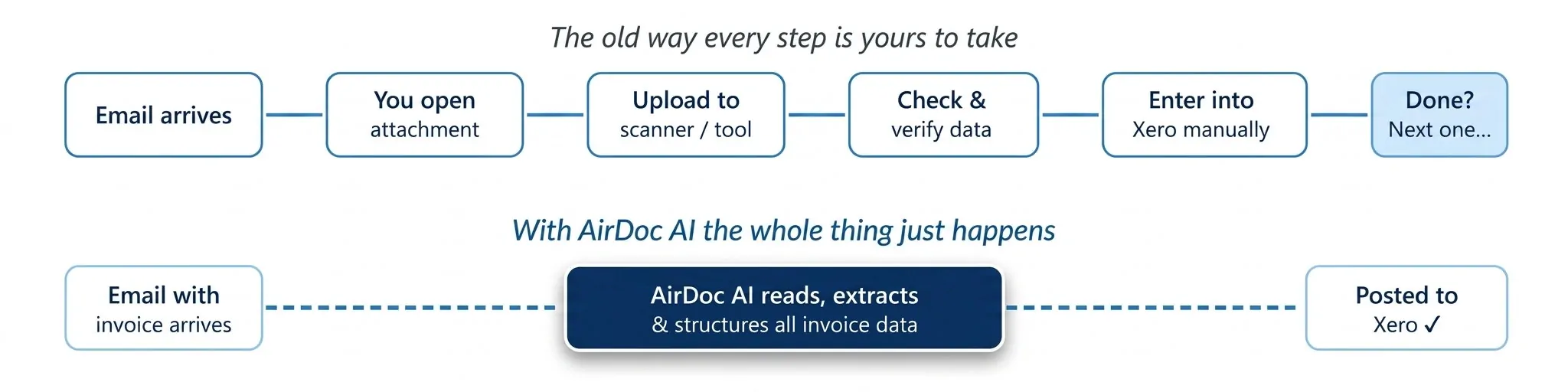
Top: the traditional approach, where you are every step. Bottom: the AirDoc AI way your inbox
connects directly to your books.

What makes this different and why it matters

AirDoc AI does something that, until now, no other tool in this space has actually done cleanly: it connects directly to your email inbox. Not a scanning portal. Not a mobile app you photograph invoices with. Your email. The place invoices already land, every single day, without you doing anything.

The moment an invoice arrives in your inbox, AirDoc AI sees it. It reads the attachment regardless of whether that’s a PDF, a scanned document, or an emailed invoice and identifies the relevant data, and posts it accurately to Xero. Supplier name, invoice number, line items, GST, due date. All of it. Without you opening a single attachment. (If we encounter any problems with any invoice, we always flag them as well so that you can intervene only in such scenarios but AirDoc AI always learns from how you fix such cases as well)

This might sound like a small distinction. It isn’t. Every other tool in this space still requires a handoff from you. You are still the bridge. AirDoc AI removes that bridge entirely, which means you’re not just working faster you’re genuinely not working on this at all.

The hands-off difference

Most automation tools reduce the steps you take. AirDoc AI eliminates your involvement altogether. By connecting directly to your inbox, it catches every invoice the moment it arrives no uploads, no logins, no checking. Your books stay current without you lifting a finger.

A walk through what actually happens

For those who like to know exactly what they’re handing over here’s the full picture of how AirDoc AI works in practice.

01

Inbox connection

AirDoc AI connects securely to your email account. It watches for incoming emails with invoice attachments PDFs, scanned docs, or inline invoices.

02

Intelligent identification

Not every email with an attachment is an invoice. AirDoc AI identifies genuine invoices automatically, ignoring everything else.

03

Data extraction

Supplier details, ABN, invoice number, individual line items, GST amounts, totals, and due dates extracted accurately, every time.

04

Xero posting

The extracted data is posted directly and accurately to your Xero account coded, categorised, and ready for your review or approval.

AirDoc AI reads every field from the invoice and maps it precisely into Xero line items, GST, due dates,
the lot.

This is the era of letting go

There’s a quiet transformation underway in how Australian businesses operate, and it doesn’t always make the headlines the way it deserves to. The businesses that are pulling ahead right now aren’t necessarily the biggest or the best-funded. They’re the ones that have figured out which parts of their operation deserve human attention and which parts don’t.

Invoice processing is a perfect example of the latter. It is rule-based, repetitive, and well-defined. It has a known input (an invoice), a known output (an entry in your accounting software), and a well-trodden path between the two. There is no nuance that requires your judgement. There is no client relationship that depends on your instinct. It is, in the most literal sense, a task designed to be automated.

What AI has done genuinely, practically is make that automation accessible. Not to large enterprises with expensive ERP systems and dedicated IT teams. To the bookkeeper running accounts for three SME clients. To the founder of a 15-person manufacturing business in Brisbane who does their own accounts on Saturday mornings. To the finance manager at a growing wholesale company in Melbourne who is drowning in supplier invoices every Monday.

BEFORE AIRDOC AI

  • Hours per week spent on invoice entry

  • ⚠️

    Occasional data entry errors affecting reconciliation

  • 📥

    Invoices sitting unprocessed in inbox

  • 😴

    Best hours spent on lowest-value work

  • 🔄

    Same task, every week, forever

WITH AIRDOC AI

  • Invoices processed the moment they arrive

  • Accurate extraction every field, every time

  • Xero always up to date, without you touching it

  • Your time reclaimed for work that actually needs you

  • Complete inbox-to-books automation, end to end

What do you do with the time you get back?

This is the question that doesn’t get asked enough when people talk about automation. The conversation usually stops at efficiency you’ll save X hours, you’ll reduce Y errors. All true. But the more important question is: what becomes possible when the grind is gone?

For an accountant or bookkeeper, reclaimed time typically flows into the work that actually builds a practice. Advisory conversations with clients. Proactive cash flow analysis. Spotting unusual patterns in spending. The kind of work that strengthens relationships, drives better decisions, and genuinely can’t be done by a machine. The work that, if you’re honest with yourself, you got into this field to do.

For a business owner doing their own books, it’s simpler: it means getting Saturday mornings back. It means not being behind. It means one less thing that follows you home from the office.

“The businesses pulling ahead aren’t the ones working harder. They’re the ones that have decided certain work belongs to software and they’ve acted on that decision.”

Handing off invoice processing to AirDoc AI isn’t just a productivity upgrade. It’s a signal to yourself, to your team, to your clients that your business is operating in the present. That you’ve made the conscious decision to use AI where it belongs, so that human capability can go where it’s irreplaceable.

Companies in every sector are making this transition right now. The ones that do it thoughtfully choosing the right tools, implementing them carefully, and redirecting the freed-up capacity toward higher-value work are the ones building the kind of operations that will still be competitive in five years. Not because they automated for automation’s sake, but because they understood what the technology was actually good for.

Small step, real shift

Connecting AirDoc AI to your inbox and your Xero account takes minutes. The change it creates is immediate and permanent. From that point on, every invoice that arrives in your inbox gets processed, extracted, and posted without you being involved at all.

That’s not just convenience. In a market where time, accuracy, and focus are the real competitive currency, it’s an edge worth having.

See AirDoc AI in action

Connect your inbox. Watch your invoices process themselves.
Your books will be more current than they’ve ever been.